Thursday, October 15, 2009
www.visuwords.com
Tuesday, October 13, 2009
Teacher Professional Development: LESSON STUDY
Once the lesson is created, one member of the group teaches it to students, while the others observe the students and take notes for their future discussion. The teacher is not evaluated, as the group created the lesson, but the extra sets of eyes help to identify problems and/or successes the students may experience as they learn the concept.
Following the initial teaching, the group reassembles and reworks the lesson plan to incorporate the feedback, and then it is retaught with the same purpose. The idea behind this practice of professional development is that teacher growth is most effective when it is embedded on the job, and it needs to occur in smaller occurrences to be sustainable.
This is a very interesting topic. I think it is a logical extension of what we are doing with our school-based and/or district PLC groups, and I hope to learn more about it.
The original article may be found HERE
Cheers
Saturday, October 10, 2009
Virtual Field Trips
New educational, kid-friendly episodes are uploaded every two weeks. Included are links to fun websites and our Learning Corner with follow-up questions.
Check it out....maybe you'll find it interesting?
Cheers
Friday, October 9, 2009
Interesting Documentary re: Living With Asperger's Syndrome
Tonight while making the rounds of some of the interesting places I like to stop and read (HERE), I read an amazing story about a young professional surfer with Asperger's Syndrome. He's been misunderstood for years, and plays by his own rules, and just a few years ago he was diagnosed with Asperger's. Interesting. Ah....makes sense a lot of people thought....
Surfing legend Laird Hamilton describes Clay Marzo as "an artist who can't be pigeon-holed. He's something all together different that should be cherished.".
There is a lesson in there about the effect of the assumptions and biases we all have (whether we admit it or not) when dealing with kids (whether they have ASD or not)! I want to see the movie/documentary made about this kid....it looks good....read the article linked above, and then if you have 3:24, watch the trailer here to see some amazing waves:
Cheers!
Thoughts on Grading at the JH Level
The Only Place We Should See % and Grade Together
I am comfortable with using percentage grades. They are familiar to me, I know generally how to interpret them, and I find percentage grades a pretty good descriptive snapshot. Most teachers feel the same level of comfort and understanding, and I know most parents do too.For those reasons, it is an annual occurrence, when discussing grading and reporting with parents, to have parents ask us to "...explain what these numbers (i.e. rubrics) mean..." and having to answer when they ask "Why don't you guys use percentages like we had?" They are not used to rubrics, and miss the comfort of the understanding afforded by percentages.
The problem is, we need to get rid of the percentage grading system at the JH level. For lots of reasons.
I think we are on the verge of being able to do so in my district, with the advent of our new standardized elementary report cards. As parents develop a comfort level for this manner of reporting, one day we will be able to move to using more appropriate methods of reporting for our older students too, but it will take a very solid implementation plan to get there.
To that end, I wanted to share a few passages from an article I read earlier today that was written by Dr. Thomas Guskey, a general assessment guru and professor of Ed Psych at the University of Kentucky:
"To recover from a single zero, a student must achieve a minimum of nine perfect papers."
and
"To move from a B to an A in most schools, for example, requires an improvement of only 10% at most, say from 80% to 90%. But to move from a zero to a minimum passing grade requires six or seven times that improvement, usually from zero to 60% or 70%."
(you can read Guskey's whole article here: http://www.hopefoundation.org/nl/1009/guskey.html)
I realize what I am discussing above is much more than just how we report. The changes will need to strike first at the very heart of how we teach and what kind of feedback (and engagement) we give kids on a daily basis. It is important to start thinking about it changing how we report, because change is needed, and I believe it is on its way!
Thursday, October 1, 2009
Last One For Today
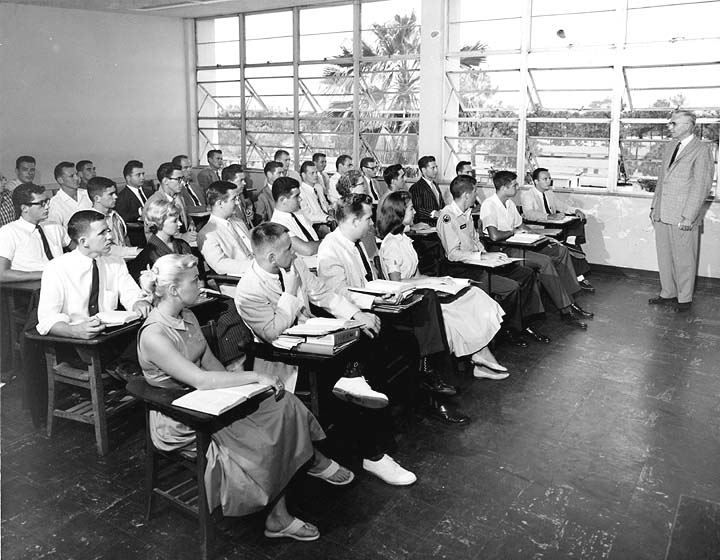
One of the presenters yesterday mentioned how little schools have physically changed over the years, and showed a couple of pictures to illustrate his point. Not being terribly original, but definitely loving the impact of pictures, I thought I would share this image here as well.
I realize there are always exceptions, and these are generalizations, but I think they are pretty accurate. Certainly my experience in the 70's and 80's as a student, and since then as a teacher, supports the pictures.
What will our classrooms look like 25 years from now. Children, society, and what we know about teaching and learning have changed a great deal since the 1900's, do our classrooms maybe need to change too?

1980s - When technology started to appear...but how many did we see like this? Or do we now see like this? (original available here)
The saying is, if it works, don't fix it. Maybe we need to reflect on the question: is it working well enough? And if it isn't broken now, how long will it be before it is broke and in need of fixing? In his book Disrupting Class, Clayton Christensen says it won't be too long now...
This gives me something to think about for the rest of the day, anyway!
Digital Indigestion and R.O.L.
It's About Time
Sunday, June 7, 2009
The Second Marshmallow
One of my favorite blogs is the GIFTED EXCHANGE, and a recent post there linked to an article in the NEW YORKER which provided the historical basis of the Marshmallow Test and shared how researchers are extending that research in an attempt to identify the specific region of the brain where self-control is located. The history of this research was interesting, and the use of fMRI technology makes sense too, but I wouldn't have thought of it going in that direction....
Fascinating stuff, and affirming as well. I think we are exactly on the right track to be trying to teach our children to improve this skill ("Stop and think") and to understand why it is important. The more I read and reflect, the more benefits I see to teaching our young students the value of self-control.
One day my mom told me that she used to tell my brothers and I no when we asked some questions, even if she did not really care if we did what we were asking about just so we would learn to hear what no means. I think she was ahead of the curve a bit with respect to teaching us delayed gratification.
Cheers
Thursday, June 4, 2009
Marshmallows and Maturity
Yesterday I came across this video on TED.com, one of my favorite sites. I have the TED app on my iPod and once a week or so check in and check out their newest videos. This short one was a very engaging summary of the 'marshmallow test'.....and it fits so well when talking about the current credit crisis so many people find themselves in right now....
Enjoy:
Thursday, May 28, 2009
I'm thinking I'm not in Kansas anymore...
I'm currently reading Current Issues and Trends in Education and (again) on the surface I do not have a great deal of experience with some of the issues and trends I have read about to this point. Racial diversity in a gateway urban setting such as San Francisco or New York City is different than racial diversity in Grande Prairie. Violence in some larger school jurisdictions just does not compare to the school violence we experience.
Education here seems to be quite different than education in, say, San Francisco. Is it?
I have given this a great deal of though over the last couple of days and I think our overall experiences are not substantially different, but rather they are reflective of the scale of our differences. I believe the issues and trends occuring in our little old town are more similar than I first thought. They are just smaller. I think.
During my next Ed.D. class, Social Contexts and Contemporary Issues, I am going to get a chance to see if this theory holds true. I look forward to the opportunity to compare and discuss the at-risk students in my environment with those in larger, more globally representative urban settings. I'll get to compare the educational experiences of our first nations students to that of the Asian-Americans and Hispanics. Etc. I am looking forward to this more than any course I have taken in a long time. I have reflected on this at great length and I think the challenges we face in all of education really do align despite the surface differences.
My guess is it comes down to our systems.
I look forward to the learning I am going to experience with my peers from Hawaii, LA, Las Vegas, etc. I think at this point kids are kids, and the skills we must possess to address their needs are the same. The needs differ somewhat though, and I look forward to testing my hypothesis.
For anyone that stops by to read this...what do you think? Am I naive? Missing something? Outright wrong? Drop a comment and let me know what you think....
Cheers
Monday, May 18, 2009
Phwew!
Tuesday, April 28, 2009
I can't wait to ditch the cables....
Imagine, laying your phone down on a pad on your desk and it charges. Or collecting power over wifi....holy cow....
After seeing a prototype Kyocera foldable OLED screen the other day, and thinking of it in terms of educational applications......I seriously need to step back and try to grasp the BREADTH of the impact these sorts of evolutions are going to have on teaching and learning, let alone society....
No more laptops even.....and really....for doing our investigations (will it still be called teaching if it is all about learning?) will we even need classrooms for the big kids?
Cheers
Monday, April 27, 2009
Innovation in Education
I have been doing a fair bit of coursework in the last week or so on the topic of innovation in education. In particular, we have been discussing the boundaries or barriers to innovation.
I’ve been thinking that our ability to innovate in education seems to be dependent upon personalities and their predisposition towards the concept of innovation. It seems too though that our current government ministry seems inclined to look for ways to innovate though, so I am wondering how we could build the idea of innovation into our SYSTEM? Is our archaic system ready for pushing the boundaries of innovation?
Or is that what AISI is for? We may be on the conservative side with those projects…
Cheers
Saturday, April 4, 2009
A NEW STRUCTURE FOR LEARNING...
I’ve just finished doing some reading about how the entire Adams 50 School District (~10 000 students in metro Denver) is moving AWAY from graded classes, to standards-based multiage groupings. Students will only move from one level to another with a B average, essentially ensuring all HS graduates leave with a 3.0 average (minimum).
This is an interesting concept….I think it warrants more investigation. One of the features I’ve seen promoted that appeals to me the most is the idea that the students would have a lot of say in the operations, rules, etc.
Very exciting, I think! And LOTS to read about on this topic HERE.
Cheers
Thursday, April 2, 2009
I Just Had to Say...
This is cooool…..I’m having a good tech day……I figured out how to embed video onto our school website. I think this is going to make the ‘School Tour’ page a lot more interesting, at least. I think there are a great many other, more educational uses too. For now though, we test…..
The embedded Student News of the Day looks pretty impressive on that portal front page!
Saturday, March 28, 2009
Something Just For Fun?
Friday, March 27, 2009
The Future of Technology in Education...
I’ve just started reading the HORIZON REPORT: K- 12 Edition. This report addresses six technologies that the New Media Consortium suggests are going to be rapidly emerging in our K – 12 environments over the next few years.
Monday, March 23, 2009
21st Century Learning...
I thought of that point again tonight when I heard this line from John Legend's song "If You're Out There": "The future started yesterday and we're already late!"
Thinking about this just leaves me with more questions.....Are we already late for the future? What do we need to do to catch up to the future? Anything? Or is it like buying a PC and we are ALWAYS going to be behind? What kind of reform is coming to our schools? I think I had better start reading my new book....Disrupting Class.....maybe the answers are in there.
Cheers
Sunday, March 22, 2009
Digital Story Telling
http://sites.google.com/site/digitalstoryworkshop/
Cheers