Friday, November 27, 2009

Google Documents for Teachers

I came across this good introduction to Google Documents for teachers (see below) the other day.

I know I have posted about Google Docs before, but I think we are missing an opportunity here for having students work collaboratively on one document. This is an area where I believe we need to do more!

There are other potential benefits to having students use this impressive suite of tools to collaborate on work at home and at school too, not the least of which is removing compatibility issues and helping to share documents.  The history function is potentially helpful too!


 On my to-do list is learning how to use Google Forms. It looks interesting, almost like a survey application in some ways.

If your students are doing lots of collaborative work, Google Docs might benefit them more than using other more popular applications. They do require a Google account (gmail address) to use this however, which may be a problem depending upon the students' age and/or school or district policies regarding having students sign up for external email addresses.

Cheers
FQFP8FV2S2G6

Tuesday, November 24, 2009

Shameless Plug For a New Blog I Like

How could I not put in a plug for what is likely the best blog started by a grade 6 student this month?

Take a minute, if you can, and pop by and check out my son's blog. He's put up some videos of some trebuchet prototype designs he has built from lego, in preparation for building a wooden one later.


Well done buddy!

Cheers

Meaningful PD - How Great Does This Sound

Tonight I was reading one of the educational blogs that I subscribe to in my RSS feed ( and I came across an online post that I felt addressed our current PD needs perfectly.  I found it very affirming for the district I work in because I believe we try to tap into our expertise in this manner regularly!

I sometimes worry that we are making too much use of our experts, but it sure is impressive to consider the expertise that exists in our schools.

On Ian Juke's Committed Sardine blog I read an article from the Dean of Instruction at Noble Stree College Prep school in Chicago, title 'When Teachers Are the Experts: From Traditional to Collaborative Pro D'.  I'd love to hear your thoughts on this short article summarizing the shift taking place in our schools.

The post is available here: 
http://tinyurl.com/sardinesforEDA564

(or search the blog entries at http://committedsardine.com/blog.cfm , I just shortened the URL when I posted this link to my class)

For what it is worth, I agree with Ian. I'm going to miss the donuts too!

I look forward to hearing your thoughts on the post. Did anything really connect with you? Is there anything you disagreed with? Did you find anything in there that might be useful at your school? etc.

Cheers

Monday, November 23, 2009

Disrupting Class by 2019....by 2014 in College....

In his book Disrupting Class, Harvard Business School professor Clayton Christensen makes a case that half of all HS courses in the U.S. will be delivered online by 2019. He has used logarithmic graphing of present day statistics to identify the growth curve that exists for online registrations.
 
Many people question Christensen's position, but he presents pretty compelling evidence to support the growth curve being very steep, similar to exponential growth.
 
I feel Christensen's prediction could come true. His argument makes sense.  I don't necessarily know what we need to do about it yet, but I think it could come true and we better start getting prepared soon. I also think the future is part online, and part on the ground, where the majority of students will be in blended programs. They may even be online, at school!
 
All the uncertainty, and excitement, I feel for the possibility of big changes in public school enrolments aside, today I read about something a bit closer to us than 2019.
 
2014 to be precise.
 
On October 21 I shared some information from a webinar I attended with Ambient Insight Chief Research Officer Sam S. Adkins (content below). Today I read a summary Ambient has produced about college students participating in online courses. They predict 2014 will be a big year. Let's look at their numbers using a NOW and 2014 comparison.
 
NOW (fact)
100% online courses: 1.25 million students
100% traditional courses: 15.14 million students
Blended courses: 10.65 million students
 
2014 (prediction)
100% online courses: 3.55 million students
100% traditional courses: 5.14 million students
Blended courses: 18.65 million students
 
What do you make of all that?  Are these numbers reasonable?  Knowing that colleges need to make money too, are there any lessons in these numbers?
 
I think there might be....
 
For what it is worth, full disclosure is that I am taking courses online right now. The courses I am taking are excellent, and much like in a regular classroom, the quality of the teacher makes the course. 
 
the whole article on Adkin's predictions is available here:
 
Cheers

Sunday, November 22, 2009

Brain-Based School Design

In our line of work, education, we hear a great deal about making use of what we know about the brain to influence our teaching and student learning.
 
The problem is, most of us don't know much about how the human brain works. Sure, we know we all have different learning styles, and that our brain changes over time, and other things. But when it comes to concrete, instruction-specific knowledge, I believe in general we don't know much at all.
 
And, I think that is too bad, and due to change in relatively short order. People are going to demand changes, sooner rather than later.
 
One of the topics I have been most prone to discuss in the past 18 months is the need for education to be more responsive to the individual needs of the students. I believe completely a relevant, meaningful, and appropriate education will engage all students.
 
Fullan, in one of his books (sorry no reference, its late, if you really want it, email me and I'll send it to you. Breakthrough I think but I'm not getting up to check) spoke about the need for precision and personalization in education, coupled with professional learning. Daniel Pink, in his book A Whole New Mind, describes our current design era as being notable for people's desire to have their lives customized to meet their specific needs. Clayton Christensen talks about how virtual education will help meet the unique needs of more students by allowing them to learn online while also in traditional school settings. All of these resources exist because we are trying to learn more about how we learn.
 
All 3 of the examples in the last paragraph address the same concept, and I believe the underlying reason for the similarities is that people (parents/students) are slowly starting to recognize in many cases they can always get what they want.
 
Recently, the Toronto Star ran an 8-part series on brain-research and its applications to education. It is a brilliant collection of brief articles put together by the 2008 Atkinson Fellowship in Public Policy winner Alanna Mitchell. If you are involved with education, I HIGHLY ENCOURAGE you to read this series. When you are reading it, don't think about the changes that are difficult for us to comprehend. Think about the POTENTIAL that exists for student learning if we could somehow make this knowledge evident in our practice! 
 
Isn't that potential impressive? Do you want education for your children, or grandchildren, like those students in the Australian HS are getting?
 
The series is located here: http://www.thestar.com/topic/Atkinson2009 . Please read it. It's likely the most important post I've made on this blog in a long time! And when you read it, dream BIG!
 
Cheers

Wednesday, November 4, 2009

Of Data and Perceptions and New Ways of Looking at the World

I spent 20 minutes last night listening to a fascinating presentation on new ways of looking at the separation that exists between countries in the world, and how the gap between countries has narrowed over the past couple of generations.

I hope you have some time to watch the video, the presenter, Hans Rosling, provides an inspiring use of statistics! In general, his point is that the way we look at the world (our mindsets) are often based on old information and that the modern way the world is (represented by his datasets) is significantly different.

For teachers of Social Studies, or History, or even Mathematics, this video could potentially be quite useful!


If you would rather watch the video full screen from its original location at TED, click here.

I hope you enjoy it!

Cheers

Thursday, October 29, 2009

MOVING THE BAR and INCREASING GRADUATION RATES

For many years an oft-repeated phrase in education was that we needed to raise the bar, meaning we needed to establish higher expectations and help all students attain those higher levels of achievement. I am not a high school teacher, and it has been close to 20 years since I taught in a high school, but I am thinking that the bar has been raised considerably at the high school level.


Thinking back to what I worked on in high school, and what I hear students are working on today in the higher level courses, makes me think that it must be a heck of a lot tougher to be in HS now than in the past. Is that not raising the bar?


By that thinking, the fact that our graduation rates are higher today than they were 20 years ago it makes me think that our schools have done a good job of helping students get up and over the higher bar.


I started thinking about this notion while reading an article online the other day about how schools in Des Moines Iowa are considering creating a fast track high school diploma intended to graduate more students with fewer credits and keep kids from dropping out of school. Is the idea being considered in Iowa proof that we have raised the bar considerably? One rationale presented in support of the concept is the fact that graduation requirements are up considerably since the 1980’s…


What do parents and employers want? What skills are they expecting graduates to have, and can those be learned in a fast track setting?


This school reform stuff is tricky business…


Cheers

Thursday, October 22, 2009

More On Common Sense

I love the concept shown in the following video. I think the FUN THEORY makes perfect sense. I also think it is a VW marketing campaign....but that works for me and I'm OK with that...

What I'm thinking about now though, is what applications does this have for kids and school?

Relevance is not the only factor that increases motivation. Fun plays a part too. What old ways can we get rid of and replace with new fun ways of getting to the same place?

Spelling lists and tests? Math basic facts? Tests? There are lots of educational escalators out there!


Cheers!

Wednesday, October 21, 2009

The Virtualization of Education

I attended an online webinar earlier today, sponsored by Ambient Insight, an online market based research firm, on the topic of the virtualization of education. I've read more and more about this topic online of late. It is hard to avoid hearing about it online, and Clayton Christensen's book Disrupting class: How disruptive innovation will change the way the world learns has made its way around our district so there's been some discussion locally as well.

This is a topic that fosters great discussion among educators and the public alike. Everyone has an opinion on school, and most people I've talked with are firmly in the camp that there is little chance online learning will substantially impact traditional education

I disagree. Ambient's research, and predictions based on existing trends, would seem to support my position! Here is a slide from their presentation showing the growth of pre-K-12 online learning:


What I find really interesting though is the predicted growth of blended learning that takes place in both schools and online. Check out the growth in the yellow slice of pie, above! Here is some other interesting, recent, information:


Even the U.S. Government appears to be getting in on the game. Here is a slide providing an overview of a recent US Education report, with the headline touting the effectiveness of online learning! In one of the most interesting parts of today's webinar, the presenter was talking about the number of U.S. states that are starting to mandate giving students access to online learning. The topic of cost savings came up when it was shared that online students draw, on average, half of what brick and mortar students get in education funding. Those are potentially huge savings.


The final interesting point I took out of today's webinar is this final slide, showing the evolution of a variety of different online educational trends. LMSs, which we have spent so much time focusing on, yet don't even use yet, are the first wave with Social Learning Platforms the third wave. Licensing models are moving towards no licenses, and business models are then looking to collect $ from subscriptions and advertising.


The social part of these trends is what appealed to me the most. Research I have read suggests teachers and pedagogy are at the top of the list in determining the effectiveness of online education. Social networks are taking off, and the trend is for peer to peer social learning to take more of a role with teachers developing more of a facilitator role than providing direct instruction.

I don't think there is going to be any avoiding this, and I also think that if we do this right, many of our students are going to benefit and get better educations than they do now.. I think I see some more reading in my future.

Cheers


(if you want the .pdf of the whole presentation, it is available along with others here: https://sas.elluminate.com/site/external/event/playback)

Stunning New Research!

Well, I don't know if this is earth-shattering news or not, but it certainly gave me a good laugh this morning.

I am signed up for the Association of Curriculum, Supervision and Development (ASCD) Smart Brief. Every day relevant stories are sent to my inbox in the form of this Smart Brief, helping me to keep current with what is happening in K-12 education outside of my district.

Today, I think, one of their headlines made it past the editors without getting caught. It gave me a good laugh to read:

Eye on Curriculum

My first thought was "Really? I never would have thought that!"

Sarcasm aside, the more I thought about it the more it made me think of how important it is to give kids the opportunity to learn by doing. Working on projects, engaging in relevant exercises, and having to go back and make changes because the results were not acceptable is how I learn best, and I think how most people learn best.

Do we do enough of that in our schools? Now that is authenticity in learning!

Cheers

(if you want to sign up for smart brief, check here: http://www.smartbrief.com/ascd/ I highly recommend it)

Thursday, October 15, 2009

www.visuwords.com

Thanks to our colleague, Mr. Funk, I will likely never be at a loss for words again!
 
Today I was directed to www.visuwords.com, which is an online dictionary with a twist. Instead of defining a word, visuwords gives you a visual representation of the definition as well as illustrating links your word has with other words, derivations, etc.  The picture with this post is a screenshot of the result for searching the word "KNOWING".
 
Immediately I thought of all of those students I have worked with over the years who did not have a strong vocabulary. They recognized words when they heard them, but struggled to come up with them when working on writing activities in class.  With this visual search engine, no longer will a student need to say "I can't think of anything else to write about.". If they are interested in hockey, then can enter the word in and be given all kinds of ideas for directions to take their writing in. This program is simple, but it just makes sense!
 
Give it a look, I think you'll be amazed at its utility too! If I can think of a use for this, imagine what an expert in teaching writing could do?
 
Cheers

Tuesday, October 13, 2009

Teacher Professional Development: LESSON STUDY

In today's edition of the Washington Post there is an article describing an elementary school's use of a technique known as 'Lesson Study' to improve teacher knowledge and ability. Lesson Study is a practice that originated in Japan, and see's teachers working together weekly to create and refine specific lessons.

Once the lesson is created, one member of the group teaches it to students, while the others observe the students and take notes for their future discussion. The teacher is not evaluated, as the group created the lesson, but the extra sets of eyes help to identify problems and/or successes the students may experience as they learn the concept.

Following the initial teaching, the group reassembles and reworks the lesson plan to incorporate the feedback, and then it is retaught with the same purpose. The idea behind this practice of professional development is that teacher growth is most effective when it is embedded on the job, and it needs to occur in smaller occurrences to be sustainable.

This is a very interesting topic. I think it is a logical extension of what we are doing with our school-based and/or district PLC groups, and I hope to learn more about it.

The original article may be found HERE

Cheers

Saturday, October 10, 2009

Virtual Field Trips

This is a very interesting site that I think might have an elementary focus. I enjoyed looking at the content I checked out, and I can see that it might be useful in class. Maybe on a SMARTboard during an inside recess? Or for playing at lunch? Or perhaps there is a trip that fits with your curriculum?
 
I LOVE the video book reviews - these are dead simple to do! Perhaps you could do some of these?
 
Maybe you and your class could create and submit a virtual field trip to somewhere local and see if you can get it put it online?
 
The following description is from their homepage, located at http://www.meetmeatthecorner.org/:
 
MEET ME AT THE CORNER, Virtual Field Trips for Kids takes you to meet fascinating people from all over the world.

New educational, kid-friendly episodes are uploaded every two weeks. Included are links to fun websites and our Learning Corner with follow-up questions.

Check it out....maybe you'll find it interesting?

Cheers

Friday, October 9, 2009

Interesting Documentary re: Living With Asperger's Syndrome

Not too long ago I read that Autism Spectrum Disorders affects over 1% of all school-aged children in the U.S.. You'll have to Google it, I don't have a reference for that, but THAT is a lot of kids!

Tonight while making the rounds of some of the interesting places I like to stop and read (HERE), I read an amazing story about a young professional surfer with Asperger's Syndrome. He's been misunderstood for years, and plays by his own rules, and just a few years ago he was diagnosed with Asperger's. Interesting. Ah....makes sense a lot of people thought....

Surfing legend Laird Hamilton describes Clay Marzo as "an artist who can't be pigeon-holed. He's something all together different that should be cherished.".

There is a lesson in there about the effect of the assumptions and biases we all have (whether we admit it or not) when dealing with kids (whether they have ASD or not)! I want to see the movie/documentary made about this kid....it looks good....read the article linked above, and then if you have 3:24, watch the trailer here to see some amazing waves:


Cheers!

Thoughts on Grading at the JH Level

The Only Place We Should See % and Grade Together

I am comfortable with using percentage grades. They are familiar to me, I know generally how to interpret them, and I find percentage grades a pretty good descriptive snapshot. Most teachers feel the same level of comfort and understanding, and I know most parents do too.

For those reasons, it is an annual occurrence, when discussing grading and reporting with parents, to have parents ask us to "...explain what these numbers (i.e. rubrics) mean..." and having to answer when they ask "Why don't you guys use percentages like we had?" They are not used to rubrics, and miss the comfort of the understanding afforded by percentages.

The problem is, we need to get rid of the percentage grading system at the JH level. For lots of reasons.

I think we are on the verge of being able to do so in my district, with the advent of our new standardized elementary report cards. As parents develop a comfort level for this manner of reporting, one day we will be able to move to using more appropriate methods of reporting for our older students too, but it will take a very solid implementation plan to get there.

To that end, I wanted to share a few passages from an article I read earlier today that was written by Dr. Thomas Guskey, a general assessment guru and professor of Ed Psych at the University of Kentucky:

"To recover from a single zero, a student must achieve a minimum of nine perfect papers."

and

"To move from a B to an A in most schools, for example, requires an improvement of only 10% at most, say from 80% to 90%. But to move from a zero to a minimum passing grade requires six or seven times that improvement, usually from zero to 60% or 70%."

(you can read Guskey's whole article here: http://www.hopefoundation.org/nl/1009/guskey.html)


I realize what I am discussing above is much more than just how we report. The changes will need to strike first at the very heart of how we teach and what kind of feedback (and engagement) we give kids on a daily basis. It is important to start thinking about it changing how we report, because change is needed, and I believe it is on its way!

Thursday, October 1, 2009

Last One For Today

I attended a webinar yesterday on the topic of virtual learning. As I've posted earlier today, this topic holds great interest for me. I've enjoyed seeing it evolve from online correspondence materials to true, engaged learning. The program I am taking through the University of Phoenix has been the icing on the cake for me in this sense, as it is amazing learning. I can see how it would not be for some people, but for those who could succeed in this model I think we are doing them a disservice by not providing them with the opportunity.

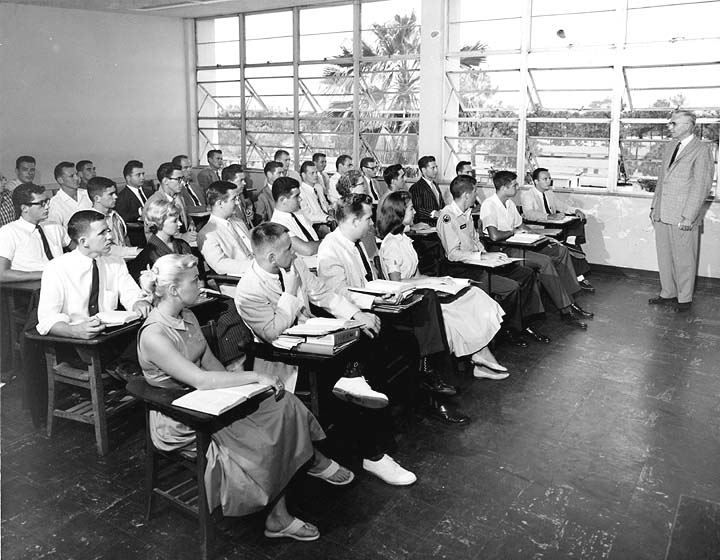
One of the presenters yesterday mentioned how little schools have physically changed over the years, and showed a couple of pictures to illustrate his point. Not being terribly original, but definitely loving the impact of pictures, I thought I would share this image here as well.

I realize there are always exceptions, and these are generalizations, but I think they are pretty accurate. Certainly my experience in the 70's and 80's as a student, and since then as a teacher, supports the pictures.

What will our classrooms look like 25 years from now. Children, society, and what we know about teaching and learning have changed a great deal since the 1900's, do our classrooms maybe need to change too?

When you look at the pictures below, do you see any similarities?
1900s (original available here)


1930s (original available here)


1950s (original available here)


1970s (original available here)


1980s (original available here)


1980s - When technology started to appear...but how many did we see like this? Or do we now see like this? (original available here)


The saying is, if it works, don't fix it. Maybe we need to reflect on the question: is it working well enough? And if it isn't broken now, how long will it be before it is broke and in need of fixing? In his book Disrupting Class, Clayton Christensen says it won't be too long now...

This gives me something to think about for the rest of the day, anyway!
Cheers

Digital Indigestion and R.O.L.

I read something this morning that just sort of clicked for me. Ian Jukes was describing the concept of Digital Indigestion on his Committed Sardine blog (http://committedsardine.com), describing how using technology can be like eating at a buffet. We tend to take a little of this, a little of that, and end up taking too much for us to handle. With technology we take a little video, a little interactive white board, a little photography, a little audio and end up with a jumble that leaves us with digital indigestion.
 
Jukes describes the need to maximize our R.O.L. (Return on Learning) by selecting technologies to integrate that maximize student learning. He describes how learning to keyboard helps students learn to write, and offers examples of how it can be done. This makes perfect sense, and it brings technology right back to the very heart of our core learning objectives.
 
The importance of technology planning, for instruction not hardware and infrastructure, makes so much sense it is a shame we don't really tend to do it in our schools!
 
Cheers!

It's About Time

Well, summer has been over for a while, and it is about time I got back on the horse. It has been far too long since I posted to the blog, and I have a lot of stuff built up that I should have posted online some time ago...so here goes, my first post of the new school year:
 
ONLINE/VIRTUAL SCHOOLING
I've been giving a great deal of thought to using online course delivery as a way to address crowding issues in schools and increase the personalization that kids get in their education. Especially for those JH kids at risk of not finishing HS, I think the possibility of their having success in a blended program might make a big difference. Success does breed success.  Yesterday I attended an online webinar and was reminded that the single most influential factor in a student having success in an online course is the teacher. It always comes back to the teacher, doesn't it? Which then speaks to how we plan and use our PD funds...
 
DID YOU KNOW 4.0
The original DID YOU KNOW has been updated yet again, and has some interesting new data about smartphone and digital information usage. The new way of doing things is not a futuristic topic. It is here. I wonder how far we are behind before we even start?  I read somewhere recently (in Disrupting Class maybe?) that the average teen has to power down when they get to school, endure school's traditional methods for the day, and then power up at the end of the day to get reconnected. I'm starting to crystallize my thinking about what that looks like, and it seems pretty important that we leverage students' technological prowess to keep them engaged in school!
 
Watch the new version here: http://www.youtube.com/watch?v=6ILQrUrEWe8
 
Cheers!

Sunday, June 7, 2009

The Second Marshmallow

I suppose it is no coincidence, I read topics that are of interest to me after all, but I find it interesting that after coming across Joachim De Posada's TED presentation I recently found another very interesting article on the concept of self-control and delayed gratification using the Marshmallow Test as the basis of the article.

One of my favorite blogs is the GIFTED EXCHANGE, and a recent post there linked to an article in the NEW YORKER which provided the historical basis of the Marshmallow Test and shared how researchers are extending that research in an attempt to identify the specific region of the brain where self-control is located. The history of this research was interesting, and the use of fMRI technology makes sense too, but I wouldn't have thought of it going in that direction....

Fascinating stuff, and affirming as well. I think we are exactly on the right track to be trying to teach our children to improve this skill ("Stop and think") and to understand why it is important. The more I read and reflect, the more benefits I see to teaching our young students the value of self-control.

One day my mom told me that she used to tell my brothers and I no when we asked some questions, even if she did not really care if we did what we were asking about just so we would learn to hear what no means. I think she was ahead of the curve a bit with respect to teaching us delayed gratification.

Cheers

Thursday, June 4, 2009

Marshmallows and Maturity

Some time ago I summarized the 'marshmallow test' with the staff at work as it fit very nicely with our vision to develop the emotional intelligence of our students. It led to some interesting discussions at work.

Yesterday I came across this video on TED.com, one of my favorite sites. I have the TED app on my iPod and once a week or so check in and check out their newest videos. This short one was a very engaging summary of the 'marshmallow test'.....and it fits so well when talking about the current credit crisis so many people find themselves in right now....

Enjoy: